Between the Lines · Essay
For a long time, I thought home had to be somewhere on a map. A point to which one could return. Today, I believe maps are too flat for that.
The things that travel with us
You never leave a place completely. Certain sounds travel with you: a spoon in a tea glass, a melody from another room, the cadence in which your name was spoken. Later, they surface without warning, in a kitchen in Hamburg or at an unfamiliar bus stop, and for a moment, distance is no longer a unit of measurement.
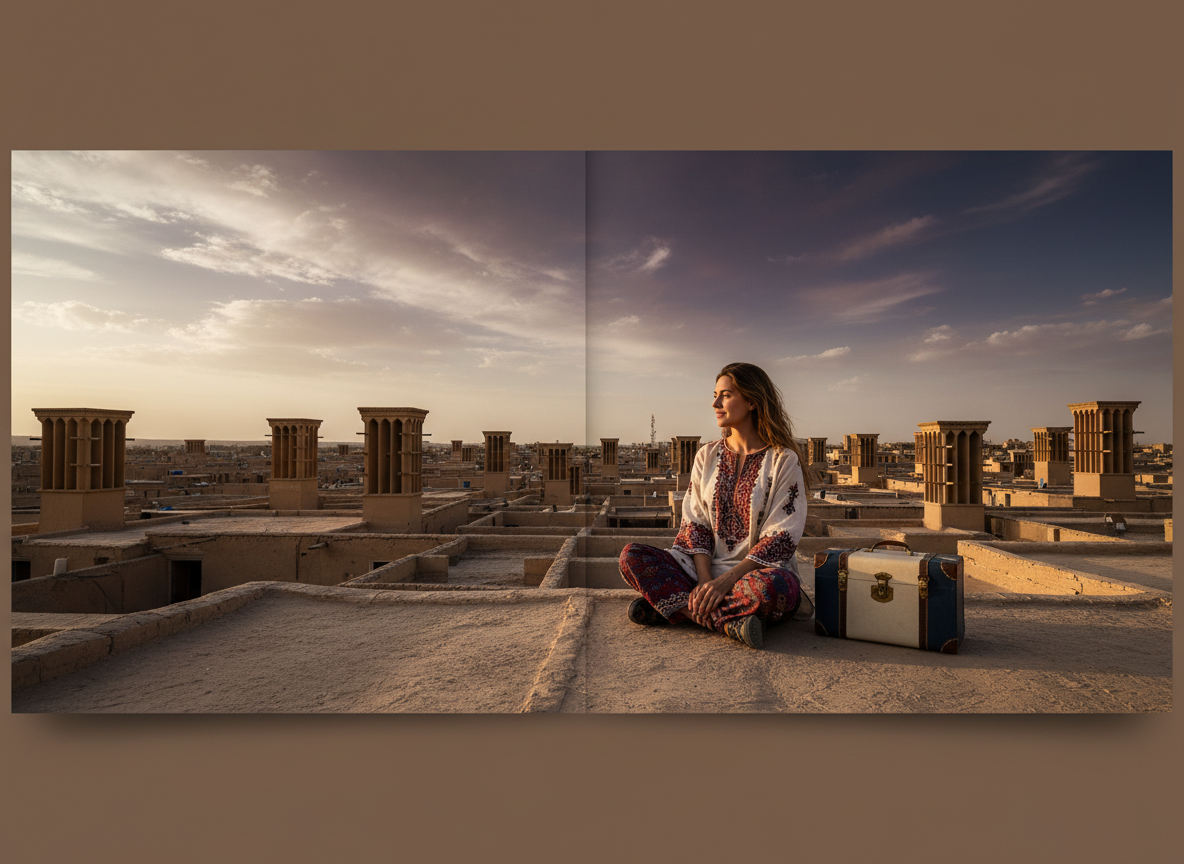
Cities also linger in the body. The dryness of Yazd, the traffic of Tehran, gardens in Shiraz—even those who know them only through family stories can inherit images. Yet inherited memory is not a title deed. It is an invitation to listen more closely.
Home without innocence
Nostalgia likes to cut away everything that does not fit into its warm light. It remembers food, celebrations, and landscapes, forgetting fear, confinement, or inequality. Perhaps home only matures when it can withstand critique. Love for a place is not the same as consent to its power.
The same applies to the new place. Gratitude for safety must not demand silence about discrimination. Belonging is not a contract in which one trades the right to dissent for refuge.
People instead of coordinates
Often, home emerges where someone does not immediately try to tidy up your contradictions. Among friends who listen patiently to a sentence spoken with a foreign accent. Among children who turn two languages into a third family melody. Among neighbors who hold onto a spare key.
Such relationships are fragile. People move away, families change, language fades. That is why home is not a state one arrives at once and for all. It is a practice of attention, care, and memory.
A place may remain
To say that home is not a place does not mean that places are unimportant. Landscape, architecture, and political freedom shape how secure a life can be. No one should have to romanticize the fact that returning is impossible or dangerous.
Yet perhaps no state alone can determine where we belong. Home can multiply without the first one disappearing. It can begin in Yazd, continue in Hamburg, and live in a language that knows no borders on any map.
The political dimension of home
Home sounds private, but it becomes political as soon as states define belonging. Passports, residence permits, border controls, and voting rights determine who may stay, return, or take part in decisions. For people from Iran, the relationship with their country of origin can be marked simultaneously by concern, longing, and legal risk. A romantic concept of home overlooks this power. It acts as if returning were merely an emotional decision and not also a question of safety, documents, and political freedom.
Belonging is also distributed unequally in the country of arrival. Accent, name, or appearance can mean that even after decades, people are still asked where they are really from. The question may not be meant with hostility, but it can draw a line. Recognition does not mean ignoring differences. It means that no one should have to explain their biography to be seen as a full part of society. Home emerges where rights are not made conditional on cultural similarity.
Perhaps that is why we need two concepts: one for the places and people that shaped us, and one for the order in which we can live freely. Sometimes the two coincide; sometimes they do not. Diaspora keeps this tension open. It allows one to remain connected to Iran while also taking responsibility in Hamburg. Home then does not become smaller, but more concrete: less a claim of ownership, more a relationship; less a myth, more a commitment to ensuring that people can live safely and with dignity in more than one place.
Belonging without a purity test
A resilient contribution should therefore begin with a clear guiding question: how people can live ties to multiple places without constantly having to prove authenticity or loyalty. This question prevents good intentions from being mistaken for good outcomes. It requires goals, means, timelines, and potential side effects to be articulated separately. Particularly in politically charged debates, this discipline is essential, as moral urgency can otherwise quickly make any question about real-world impact look like a lack of solidarity. In fact, verifiability protects the credibility of a position and makes course corrections possible before mistakes become permanent.
Analysis must include all relevant perspectives: families, circles of friends, schools, authorities, cultural institutions, countries of origin and host societies, as well as the individual. These groups do not hold the same power, bear the same risk, or have the same access to information. Participation therefore means more than an open invitation. Procedures must lower barriers, protect vulnerable people, and document which objections were taken into account or rejected. Decisions remain possible; they simply become more traceable when conflicts are not obscured behind general formulas.
Evidence must also be defined in advance. Meaningful criteria include rights, opportunities for participation, experiences of exclusion, language access, social relationships, and self-chosen forms of cultural practice. Individual metrics are rarely enough. Quantitative data should be connected with qualitative experiences, regional differences, and a transparent description of data gaps. Correlation is not automatically causation, and missing data indicates neither success nor failure. Responsible editing marks which statements are substantiated, plausibly derived, or still uncertain.
Iran can be memory, a real relationship, critique, and longing all at once; none of these dimensions entitles others to judge a life. This connection must not serve as a decorative extra or a universal explanation. Iran is socially, regionally, and politically diverse. Comparative experiences can point to options, but they do not provide ready-made solutions. The editorial standard must therefore be: concrete enough to examine decisions, cautious enough to keep uncertainty visible, and open enough for people with different experiences to offer reasoned disagreement.
What follows from this
The central conclusion of this essay is that home can encompass multiple places and must not serve as a political or cultural test of loyalty. This does not lead to a single formula. What is needed instead is a sequence of diagnosis, public deliberation, clear responsibility, and subsequent evaluation. Political and social measures should explain beforehand what problem they aim to solve, which rights are affected, and what unintended consequences are conceivable. After implementation, published results and a willingness to adjust are required. Without this cycle, even well-reasoned goals turn into assertions that avoid scrutiny.
For MIYAN, this is also an editorial commitment. The essay “Home Is Not a Place” offers a reasoned perspective, not a definitive truth. New data, better sources, and sound disagreement must be able to lead to updates. References to Iran are named concretely, without reducing a diverse country to government, crisis, or diaspora. Where information is missing, that boundary remains visible. That is precisely the value of an independent publication platform: not to produce certainty as quickly as possible, but to enable readers to evaluate arguments, interests, and evidence for themselves with greater care.